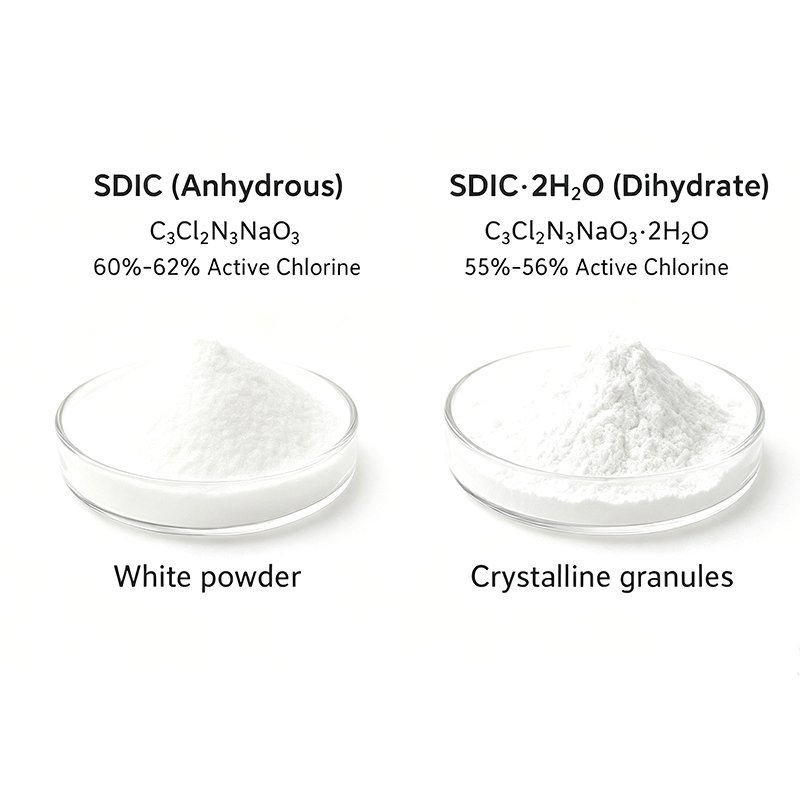
Sodium dichloroisocyanurate (SDIC or NaDCC) is one of the most widely used chlorine disinfectants in water treatment, sanitation, and industrial cleaning.
However, many buyers notice that there are two versions available on the market — SDIC (anhydrous) and SDIC dihydrate.
Although they appear similar, there are significant differences in composition, stability, and application.

1. SDIC vs SDIC Dihydrate: Chemical Composition
| Type | Chemical Formula | Molecular Weight | Active Chlorine Content |
| SDIC (Anhydrous) | C₃Cl₂N₃NaO₃ | 219.95 | 60%–62% |
| SDIC·2H₂O (Dihydrate) | C₃Cl₂N₃NaO₃·2H₂O | 255.98 | 55%–56% |
The only structural difference is two molecules of crystalline water (2H₂O) in the dihydrate form.
This small change affects the product’s weight, stability, and chlorine release rate.
2. Physical and Chemical Properties
| Property | SDIC (Anhydrous) | SDIC Dihydrate |
| Appearance | Dry white powder or granules | White crystalline granules, slightly moist |
| Moisture Sensitivity | Low | Higher (tends to cake if not sealed well) |
| Solubility in Water | Moderate | Higher (dissolves faster) |
| Stability | Excellent | Good but more sensitive to humidity |
| Available Chlorine | Higher | Slightly lower |
3. Difference in Manufacturing Process
Both products share the same raw materials and chemical reaction —
cyanuric acid, sodium hydroxide, and chlorine gas.
The difference lies in crystallization and drying:
— Anhydrous SDIC is crystallized at a higher temperature and fully dried to remove all crystal water.
It requires more energy and precise temperature control.
— SDIC Dihydrate is crystallized at a lower temperature, allowing two water molecules to remain in the crystal structure.
It is easier and safer to produce, but it has lower active chlorine per unit weight.
4. Applications and Use Scenarios
| Application | Recommended Form | Reason |
| Drinking water disinfection | Dihydrate | Dissolves faster and releases chlorine gently |
| Swimming pool sanitizer | Both | Depending on formulation requirements |
| Industrial bleaching and cleaning | Anhydrous | Higher chlorine concentration |
| Household or hospital disinfectant tablets | Dihydrate | Safer handling, less heat generation during dissolution |
5. Storage and Packaging
Anhydrous SDIC: Store in a cool, dry place; use moisture-proof packaging such as PE-lined drums or composite bags.
Dihydrate SDIC: Needs stricter sealing; avoid high temperatures to prevent caking and decomposition.
6. Which One to Choose?
It depends on your application and logistics:
Choose anhydrous SDIC if you require a high chlorine content and stability for long-distance export.
Choose SDIC dihydrate if you prioritize easy dissolution, safety, and local use.
Conclusion
Both forms of Sodium Dichloroisocyanurate are effective disinfectants.
The difference lies not in the chemical reaction itself, but in how the final product is crystallized and dried.
Understanding these distinctions helps end-users and distributors choose the most suitable type for their specific needs.
And if you need more specific needs or some professional advice, please come to contact us.