


Trichloroisocyanuric Acid (TCCA) Chemical Details
TCCA is a high-efficiency chlorine-based disinfectant widely used in water treatment, swimming pool sanitation, wastewater treatment, and industrial disinfection. It provides a stable source of available chlorine and effectively controls bacteria, viruses, fungi, and algae.
TCCA is also commonly referred to in commercial searches as trichloroisocyanurate. As a versatile TCCA chemical, it comes in different particle sizes and solid forms to meet the needs of water treatment companies, distributors, wholesalers, and industrial users.
Our TCCA products are manufactured under controlled production and quality inspection procedures to provide consistent chlorine content, dissolution performance, and product quality for bulk applications.TCCA Specifications and Forms
We supply trichloroisocyanuric acid (TCCA) in different particle sizes and solid forms according to customer requirements. Different TCCA specifications can be selected according to the application, dissolution rate, packaging requirements, and water treatment system.
Available options include:
- TCCA granules: 8–30 mesh and customized particle sizes
- TCCA tablets: available in different tablet weights and formulations
- TCCA powder: available according to application requirements
- Customized packaging for bulk distribution and industrial use
For specific requirements, customers can request the TCCA specification, COA, MSDS, packaging details, and available product forms from our sales team.

TCCA Applications
Trichloroisocyanuric acid (TCCA) is widely used as a chlorine disinfectant in commercial, industrial, agricultural, and water treatment applications.
Swimming Pool Water Treatment
TCCA is widely used for swimming pool disinfection because it provides a stable release of available chlorine and helps control bacteria, algae, and other microorganisms in pool water.
Drinking Water and Wastewater Treatment
TCCA can be used in water disinfection processes for drinking water, wastewater, and other water treatment systems where effective chlorine-based disinfection is required.
Industrial Water Treatment
TCCA is used for disinfection in industrial circulating water and other water treatment applications.
Agricultural Disinfection
TCCA can also be used for agricultural and horticultural sanitation, including disinfection of equipment, facilities, and water systems.
General Disinfection
TCCA products are used in various sanitation and disinfection applications where a solid chlorine disinfectant is required.
Why Choose Our TCCA
Consistent Product Quality
Our TCCA is manufactured under controlled production and quality inspection procedures to maintain consistent product quality between batches.
Flexible TCCA Specifications
We offer different particle sizes and solid forms to meet different water treatment and disinfection requirements.
Bulk Packaging Options
TCCA can be supplied in bulk packaging suitable for distributors, wholesalers, and industrial customers. Customized packaging can also be discussed according to order requirements.
Quality Documentation
COA and MSDS can be provided for product evaluation, import documentation, and safe handling requirements.
Export Supply Support
We support bulk export orders and can provide product documentation and shipment coordination for international customers.
TCCA Usage
The required dosage of TCCA depends on the application, water quality, treatment objective, and required available chlorine concentration.
For swimming pool treatment, TCCA dosage should be adjusted according to the pool water condition and the manufacturer’s product instructions. Users should test chlorine levels regularly and follow appropriate handling and safety procedures.
Avoid direct contact with the product and use suitable protective equipment when handling TCCA.
Packaging
Typically, we offer 50kg barrel packaging for the safety and convenience of storage and transportation. But we also provide custom packaging solutions based on the customers’ specific requirements.
The barrels we use to store the chemicals are made of high-density polyethylene (HDPE) plastic. These barrels are highly resistant to chemical corrosion and can resist the corrosion of acids, alkalis, salts, and most chemicals. The barrel wall thickness is approximately 2-5mm, and the barrel cover uses a sealing cover to prevent chemical leakage.
The labeling requirements for the barrel outer packaging completely follow GHS requirements, clearly identifying the hazards of chemicals, including label colors and symbols (such as corrosive, flammable, environmental hazard symbols, etc.). Necessary safety measures are also provided, such as treatment methods and first aid measures after contact with chemicals.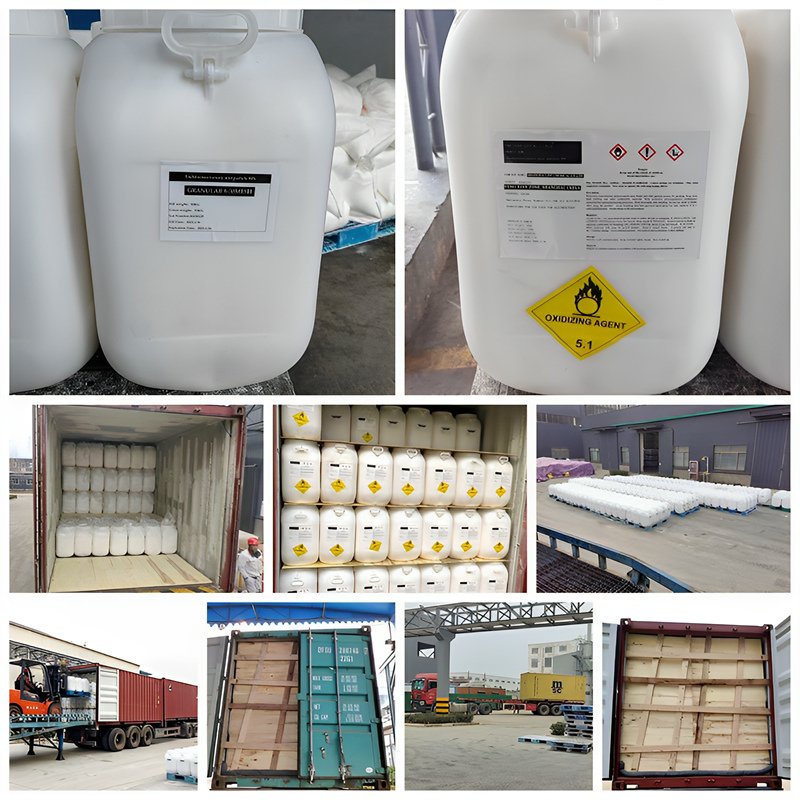
When packing, our factory operators will use forklifts to move the neatly stacked barrels of chemicals into the carriage. Each box of goods has a fixed weight limit to ensure that it is not overloaded. In addition, each layer is equipped with partitions to reduce friction between barrels.
Transportation
Typically, we use the sea transportation. But all the packaging materials are moisture-proof, waterproof, and corrosion-resistant, which can ensure the stability of chemicals and prevent leakage or reaction.
All packages are clearly noted with dangerous goods identification and safety data to meet international transportation regulations during transportation, storage, and operation, and to ensure personnel safety and environmental protection during transportation.
Meanwhile, sea transportation can accommodate a large amount of goods, especially for chemicals that are heavy and large in volume, and th etransportation cost per unit of goods is lower.
In addition, sea transportation has a wide transport network, and almost all ports can be used for sea transportation. Its transportation cycle is also relatively stable and highly secure.

